

Through the SDK
Use the manual dataset recipe to create, upload, and publish a dataset with the SDK.Through the UI
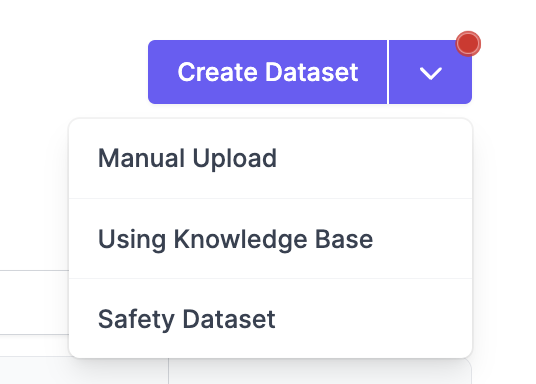
Navigate to Datasets under Evaluation, select Create Dataset, and choose Manual Upload.If your deployment shows New Evaluation Dataset instead of Create Dataset, it uses the legacy uploader. That uploader supports only Generation datasets in JSON or JSONL format. The types and formats below apply to Create Dataset → Manual Upload.
GENERATION, SUMMARIZATION, TRANSLATION, or FLEXIBLE. The modal shows the formatting instructions for the selected type.
Supported formats
The uploader supports JSON, JSONL, CSV, and XLSX. Use the format and column names shown for your selected dataset type; some configurations restrict uploads to XLSX. The examples below use theGENERATION schema. For other schemas, follow the modal’s instructions or the summarization, translation, and flexible evaluation guides. Fully flexible spreadsheet uploads use input columns to construct a mapping rather than a single input string.
CSV and XLSX generation datasets
Use these exact headers:input, expected_output, schema_type, info.
input: text sent to the application.expected_output: the expected text response.schema_type: the type of theinfovalue. UseSTRING.info: additional text context displayed to annotators.
JSON and JSONL generation datasets
A JSON file contains an array of test-case objects. A JSONL file contains one object per line. Useinput, expected_output, and expected_extra_info, with lowercase schema_type inside the context object: